Know what the billing covers
Review provider, account, service, region, reporting period, credits, discounts, currency, and source completeness. Daily views depend on the source’s coverage and refresh timing.
FINOPS FOR AI ASSESSMENT
Connect cloud billing and usage with allocation, unit economics, budgets, and provider options—so finance and engineering can make decisions from the same cost picture.
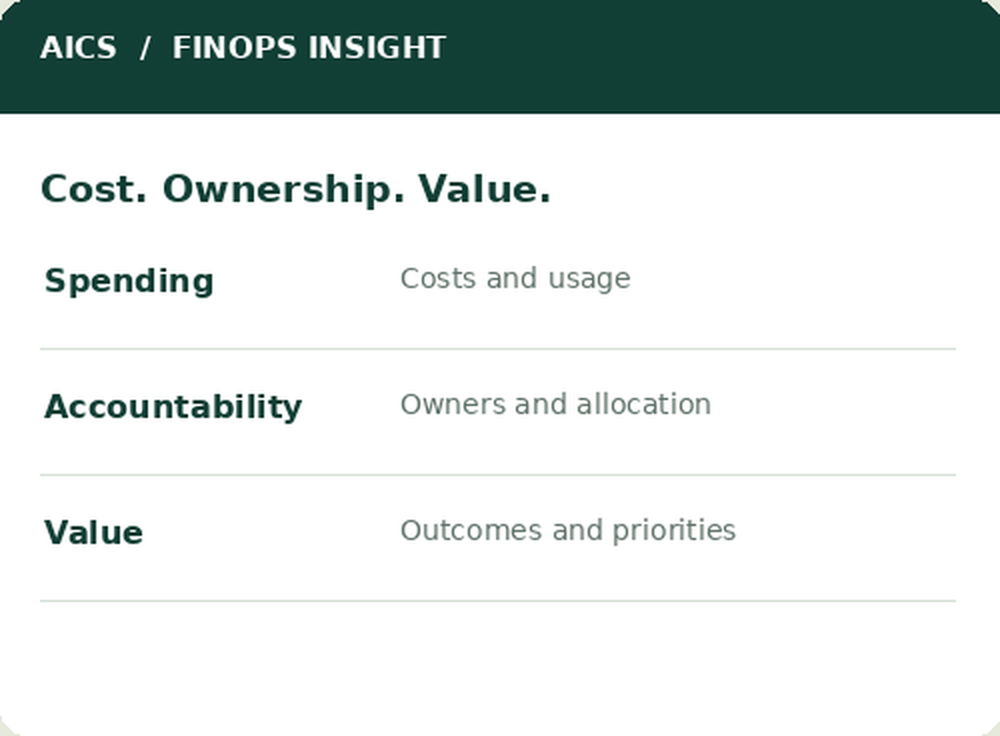
A DECISION-READY COST PICTURE
Bring billing, usage, ownership, and business output into one review so finance and engineering can see what is measured, what is modeled, and what deserves attention.
Review provider, account, service, region, reporting period, credits, discounts, currency, and source completeness. Daily views depend on the source’s coverage and refresh timing.
Review allocation by department, application, project, environment, and owner. Make shared or unassigned costs visible instead of hiding the allocation assumptions.
Compare spend with an agreed output measure, such as cost per successful request, job, transaction, or other business unit supported by available data.
OPTIONS FOR REVIEW
Model alternatives against the workload, source data, service needs, and contract terms. AICS does not make purchases or change cloud resources from the assessment.
Review idle capacity, oversized resources, unused licenses, and workload placement or timing.
Compare on-demand costs with client-provided reserved or committed offers, including term, utilization, upfront fees, and uncovered usage.
Compare storage tiers, retrieval and request charges, retention, egress, and provider volume or tiered pricing.
Review usage-based, time-based, or interruptible capacity options only where workload and recovery requirements support them.
Compare AWS, Azure, Google Cloud, or another provider using the same workload, usage, term, and quote assumptions supplied for review.
WHAT YOUR TEAM RECEIVES
The review brings evidence into a concise decision path for finance, engineering, product, and procurement.
Direct billing connections depend on supported provider integrations. Client billing exports can be reviewed where an API connection is unavailable. Modeled scenarios use the supplied rates and assumptions; they are not guaranteed savings.
COST, USAGE, OWNERSHIP
Explore the AICS FinOps workflow and sample report. Billing and scenario insights depend on your source data and stated assumptions.